Betta Fish Temperature Guide: Best Water Temp for a Healthy Betta
Betta fish need water between 76°F and 82°F (24.5°C–27.5°C), with 78°F–80°F (25.5°C–26.5°C) being the sweet spot where they’re most active, colorful, and resistant to disease. The most common mistake new betta owners make? Assuming room temperature is warm enough. It almost never is.
Bettas are tropical fish from the shallow, warm waters of Southeast Asia — rice paddies, slow streams, and flooded marshes where temperatures stay consistently warm year-round. In captivity, they need that same warmth to thrive. Without it, their metabolism slows, their immune system weakens, and diseases like ich, velvet, and fin rot become far more likely.
This guide covers everything: the exact temperature ranges, how to pick the right heater, what to do when things go wrong, and how temperature changes during treatment, breeding, and seasonal shifts.
Betta Water Temperature Chart
Here’s a quick reference for where your tank should be — and what happens when it’s not:
| Temperature | Status | What Happens |
|---|---|---|
| 78°F–80°F (25.5°C–26.5°C) | Ideal | Peak metabolism, strong immunity, vibrant colors, active behavior |
| 76°F–77°F (24.5°C–25°C) | Acceptable | Healthy, but slightly below peak — fine as a floor |
| 81°F–82°F (27°C–27.5°C) | Acceptable | Healthy, but nearing the upper limit — fine as a ceiling |
| 72°F–75°F (22°C–24°C) | Risky | Sluggish behavior, faded colors, weakened immunity, higher risk of ich |
| Below 72°F (22°C) | Dangerous | Appetite loss, immune shutdown, organ stress, possible death |
| Above 82°F (27.5°C) | Dangerous | Rapid breathing, reduced dissolved oxygen, erratic swimming, chronic stress |
Why room temperature isn’t enough: Even if your home thermostat reads 76°F, the water in your tank is typically 2–4°F cooler due to evaporation and heat loss through the glass — especially in smaller tanks. A heater isn’t optional. It’s essential equipment, right alongside your filter and tank.

Signs Your Betta’s Temperature Is Wrong
Bettas can’t tell you the water is too cold or too hot, but their behavior will. Here’s what to watch for:
Too Cold (below 76°F)
- Lethargy — sitting at the bottom, barely moving (slowed metabolism)
- Clamped fins — held tight against the body instead of fanning out (stress response)
- Loss of appetite — digestion slows dramatically in cold water
- Faded colors — less blood flow to the fins means less color
- Frequent illness — cold bettas get fin rot, ich, and velvet at much higher rates
Too Hot (above 82°F)
- Rapid gill movement — the water holds less oxygen as it warms
- Darting or erratic swimming — stress-driven hyperactivity
- Gasping at the surface — using the labyrinth organ more than usual
- Shortened lifespan — a constantly elevated metabolism burns through a betta’s body faster
If you notice any of these, check your thermometer immediately. Temperature issues are often the hidden cause behind unexplained betta illness.
Choosing the Right Heater
You need two things to manage temperature properly: a heater and a thermometer. Here’s how to pick both.
Heater Wattage by Tank Size
The general rule is 3–5 watts per gallon. When in doubt, go with the higher wattage — modern heaters have built-in thermostats that prevent overheating.
| Tank Size | Recommended Wattage | Notes |
|---|---|---|
| 3 gallons | 10–25W | Mini-submersible or small preset heaters work well |
| 5 gallons | 25–50W | A 50W heater offers the best stability at this common size |
| 10 gallons | 50–75W | Go with 75W if your room tends to run cold |
| 20 gallons | 75–100W | Adjustable heaters are ideal at this size |
If your tank is 5 gallons (the recommended minimum for a betta), a 50W adjustable heater is generally the best all-around choice.
Adjustable vs. Preset Heaters
Adjustable heaters let you set an exact temperature — say, 79°F — and fine-tune it as needed. This is especially valuable if you ever need to raise the temperature to treat diseases like ich (more on that below). They’re the better long-term investment.
Preset heaters are locked to one temperature, usually around 78°F. They’re simpler and work well in small tanks where space is tight, but you lose the ability to adjust during treatment or seasonal changes.
Recommendation: If your budget allows, always go adjustable.
Picking a Thermometer
Never rely on the heater’s dial alone — they can be off by several degrees. Place your thermometer on the opposite side of the tank from the heater to get a true reading of the coolest spot.
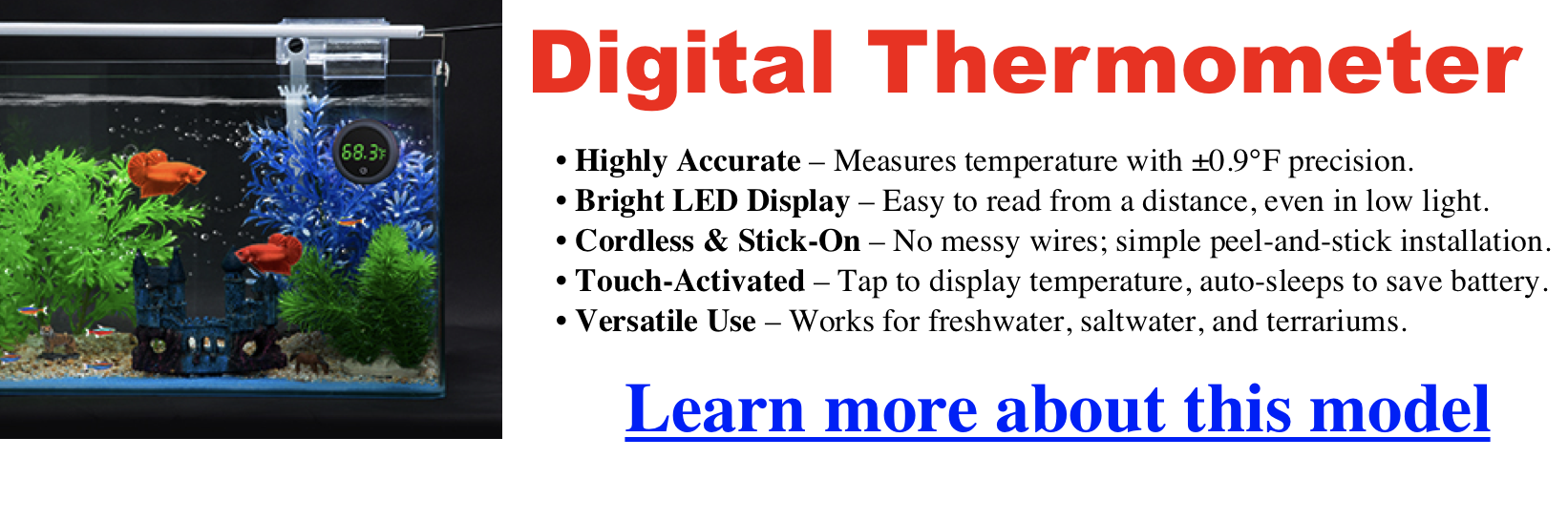
Digital thermometers are the most accurate and easiest to read. They’re worth the small extra cost.
Glass thermometers are cheap and accurate but fragile — one bump and you’re fishing glass out of the tank.
Stick-on strip thermometers measure the temperature of the glass, not the water. They’re consistently inaccurate and not recommended.
Maintaining Stable Temperature
Here’s something most guides don’t emphasize enough: stability matters more than hitting a perfect number. A betta that lives consistently at 77°F will be healthier than one that swings between 76°F and 80°F throughout the day. Aim to keep daily fluctuations under ±2°F.
Heater Placement
Place your heater near the filter output or an air stone so warm water circulates evenly throughout the tank. Submersible heaters can go vertical or horizontal — just keep them away from decorations, gravel, and plants so water flows freely around them.
Water Change Protocol
Temperature shock during water changes is one of the most common — and most preventable — mistakes. Here’s how to avoid it:
- Always match temperatures. Use a thermometer to check both the tank water and your replacement water before pouring.
- Add new water gradually. Pour slowly or use airline tubing to drip new water in.
- Never change more than 25–50% at once in a heated, filtered tank. For more on water change best practices, see our water parameters guide.
Seasonal & Environmental Tips
- Use a lid. Evaporation cools water — a lid slows heat loss significantly, especially in small tanks.
- Avoid cold spots. Keep the tank away from AC vents, drafty windows, and exterior walls.
- Summer overheating? Blow a small fan across the water surface to cool it gently through evaporation. In emergencies, float a sealed bag of dechlorinated ice water (never drop ice cubes directly into the tank).
- Winter cold snaps? Consider wrapping the tank in a towel or aquarium insulation if your home drops below 65°F at night. Make sure your heater wattage is rated for the temperature differential.
Temperature During Illness & Treatment
One of the most practical reasons to own an adjustable heater: you can raise or lower the temperature strategically when treating disease.
Ich (White Spot Disease): Gradually raise the temperature to 82°F–84°F over 24–48 hours. Higher temps speed up the parasite’s life cycle, forcing it off the fish and into the water column where medication can kill it. Combine with anti-parasitic treatment.
Fin rot: Keep temperature stable at 78°F–80°F. Clean, warm, stable water is the foundation of fin rot recovery. More severe cases may need antibacterial medication.
Velvet: Similar to ich — raise to 82°F and treat with copper-based medication in dim lighting. Learn more in our disease guide.
Columnaris: This is the exception — columnaris bacteria thrive in warm water. If you suspect columnaris, do not raise the temperature. Keep it at the lower end of the safe range (76°F) and treat with antibiotics like Kanaplex or Furan-2.
Important: Always change temperature gradually — no more than 1–2°F per hour. Sudden shifts can cause temperature shock, which is worse than the disease you’re trying to treat.
Temperature for Breeding
If you’re looking to breed bettas, temperature plays a direct role in triggering spawning behavior and supporting egg development.
- Breeding tank temperature: 80°F–82°F
- Fry tank temperature: 82°F–85°F — fry need slightly warmer water to support their rapid metabolism and growth
Higher temperatures stimulate the male’s nest-building instinct and encourage the female to develop eggs. Learn more in our betta fish eggs guide.
What to Do During a Power Outage
If your power goes out, your heater stops — and small tanks lose heat fast. Here’s how to buy time:
- Wrap the tank in towels or a blanket to insulate it.
- Float sealed bottles of warm water (not boiling) in the tank to add gentle heat.
- Keep the lid on and minimize opening the tank.
- Don’t feed your betta during an extended outage. Lower temperatures slow digestion, and uneaten food will spike ammonia without a functioning filter.
- A 5-gallon tank can lose 5–10°F in just a few hours without a heater, so act quickly.
How to Acclimate a New Betta
When you bring a betta home from the store, the water in the bag or cup is often a different temperature than your tank. Dropping a betta straight into water that’s several degrees warmer or cooler can cause temperature shock — stress, clamped fins, and a weakened immune system right from day one.
Float method: Place the sealed bag in your tank for 15–20 minutes so the temperatures equalize. Then gradually add small amounts of tank water to the bag over another 15–20 minutes before releasing the fish.
Drip method: Set up airline tubing with a loose knot to drip tank water into a container holding the betta. This equalizes both temperature and water chemistry over 30–60 minutes. It’s the gentlest approach and especially useful if the store water parameters are very different from yours.
Frequently Asked Questions
Do betta fish need a heater?
Almost always, yes. Unless your room stays at a rock-steady 78°F around the clock — including at night and during seasonal changes — your betta needs a heater. Even homes that “feel warm” often have tank water several degrees below the safe range. A heater also prevents the temperature swings that stress bettas more than being slightly outside the ideal range.
What happens if betta water is too cold?
Cold water slows a betta’s metabolism, which means sluggish behavior, poor digestion, faded colors, and a weakened immune system. Prolonged cold exposure is one of the leading triggers for diseases like fin rot and ich. Below 72°F, organ function begins to shut down.
Can bettas live in room temperature water?
They can survive temporarily, but they won’t thrive. Room temperature in most homes is 68°F–72°F, which is well below the 76°F minimum bettas need. Survival isn’t the same as health — a betta in room-temperature water is chronically stressed and far more likely to get sick.
What temperature is too hot for a betta?
Above 82°F starts to cause stress. Above 84°F, the water holds significantly less dissolved oxygen, forcing the betta to gasp at the surface. Prolonged exposure above 86°F can be fatal. The exception is short-term treatment for ich, where 82°F–84°F is used temporarily under close monitoring.
How do I cool down an overheated betta tank?
Point a small fan across the water surface — evaporation naturally lowers temperature by a few degrees. For faster cooling, float a sealed bag of dechlorinated ice water in the tank. Never drop ice cubes directly into the water, as the chlorine and sudden local cold spot can harm your betta.
How quickly do small tanks lose heat?
Fast. A 3–5 gallon tank can drop 5°F or more in just a few hours without a heater, especially in an air-conditioned room or overnight. This is why a properly sized heater is non-negotiable for small tanks.
Other Water Parameters to Monitor
Temperature is critical, but it’s only one piece of the puzzle. Fluctuating temperatures combined with poor water quality create the perfect storm for disease. You should also be monitoring ammonia, nitrite, nitrate, and pH regularly. Our complete water parameters guide covers the ideal ranges and how to test for each.
Final Thoughts
Stable warmth = a healthy betta. A reliable heater paired with a good thermometer is one of the simplest, cheapest investments you can make in your betta’s long-term health. Keep the water between 78°F–80°F, avoid swings greater than ±2°F per day, and check your thermometer daily — especially during seasonal transitions.
If you’re looking for a complete system to dial in your betta’s environment — from tank setup to feeding schedules to disease treatment — our Betta Care Guide eBook covers it all in one place, including heater sizing, water parameter cheat sheets, and step-by-step troubleshooting.