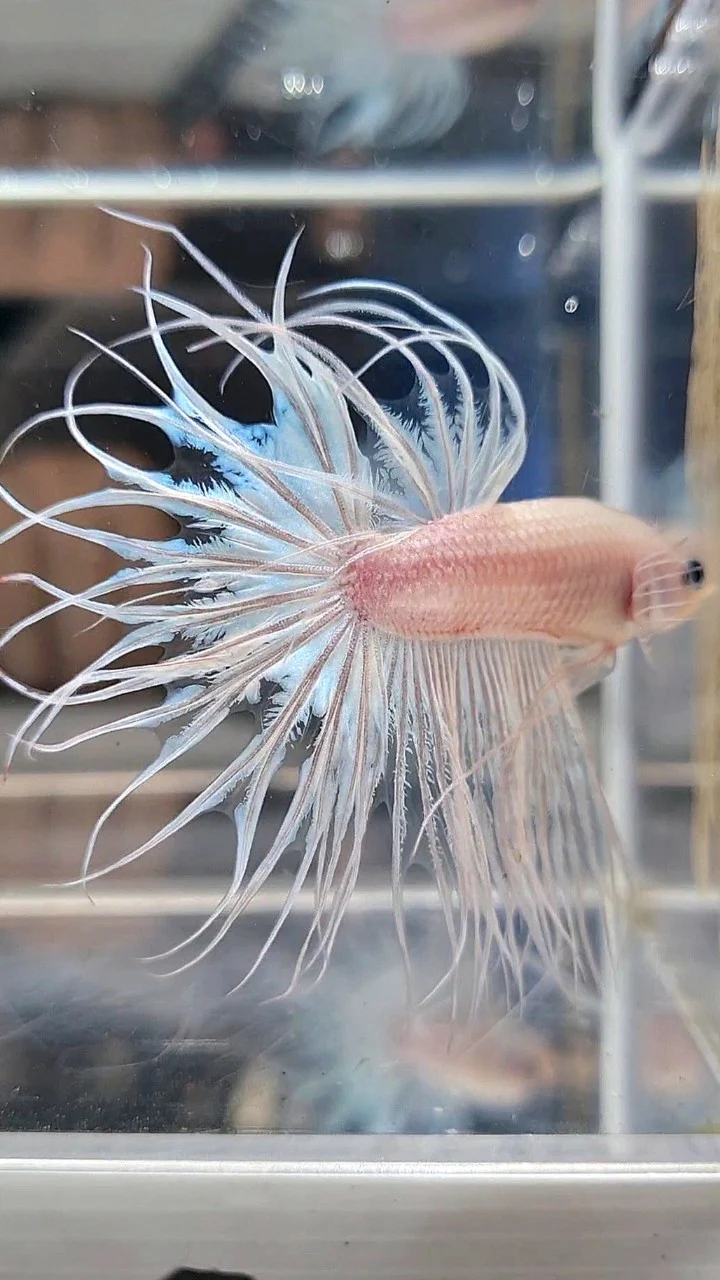
Crowntail Bettas 101: The Exotic Fish That’s Taking Aquariums by Storm

Buy Crowntail Betta Fish Here

Crowntail bettas are among the most visually dramatic freshwater fish in the hobby. Their signature spiked fins, bold coloration, and assertive personalities make them a centerpiece fish for collectors and beginners alike. This guide covers everything you need to know — from their origin and fin types to care requirements, common health issues, and where to find rare luxury variants.


Quick Facts: Crowntail Betta at a Glance

Scientific Name Betta splendens
Common Names Crowntail betta, Siamese fighting fish
Origin Southeast Asia (Thailand, Indonesia)
First Bred 1997, by Indonesian breeder Achmad Yusuf
Size Up to 3 inches (body); fins can extend 8+ inches
Lifespan 2–5 years
Tank Size 5 gallons minimum (10 recommended)
Temperament Aggressive toward other bettas; compatible with peaceful species
Price Range $25–$150+ depending on variant

What Is a Crowntail Betta?

A crowntail betta is a selectively bred variety of Betta splendens, named for the dramatically reduced webbing between its fin rays. This reduction — which must exceed 33% of the ray length to qualify as a true crowntail — creates the signature spiky, crown-like silhouette the fish is known for.

The variety was first developed in 1997 by Indonesian breeder Achmad Yusuf, who introduced the fish at the International Betta Congress under the name cupang serit. Since then, crowntails have become one of the most popular betta varieties worldwide, favored for their theatrical appearance and the wide range of colors and patterns available through selective breeding.


Crowntail vs. Combtail Betta: What’s the Difference?

These two varieties are frequently confused. The key distinction is webbing depth:

  • Crowntail: Webbing is dramatically reduced — over 33% of the fin ray — creating sharp, fully separated spikes.
  • Combtail: Webbing is reduced but still present, with soft dips between rays giving a comb-like effect rather than full spikes.

Show-quality crowntails often display 50% or greater webbing reduction, which produces the most dramatic crown shape.


Crowntail vs. King Crowntail: What’s the Difference?

  • Crowntail refers to the tail type — the spiky, reduced-webbing fin structure.
  • King Crowntail refers to a selectively bred size line that produces significantly larger, more robust fish. These are often labeled “XL” or “Luxury.”

Think of it this way: all king crowntails are crowntails, but not all crowntails are kings.


Types of Crowntail Bettas (By Fin Structure)

1. Single Ray Crowntail

The most common variety. Simple, elegant spikes with one pointed ray per fin extension. A great starting point for new collectors.

2. Double Ray Crowntail

Each fin ray splits into two, creating a more complex, layered appearance. More dramatic than the single ray and increasingly popular in the hobby.

3. Cross Ray Crowntail

Rare and striking. Rays cross and intertwine for a wild, intricate look that makes each fish genuinely unique.

4. Veiltail-Crowntail Hybrid

Combines the arched, flowing drape of a veiltail with the spiky crowntail extensions. Example: XL Veiltail Crowntail Super Multicolor Candy Purple.

5. Plakat Crowntail

Short-finned and stockier than the standard crowntail. Preferred by hobbyists who favor the traditional fighter build with crowntail spikes. Example: Crowntail Plakat Orange Candy Multicolor.


Popular Crowntail Betta Colors and Variants

Red-Based

  • Luxury XL King Crowntail Black Red Vampire — Deep black body with blood-red highlights
  • Crowntail Red Candy Multicolor — Layered red, pink, and white
  • Crowntail Black Avatar Red — Dark base with fiery accents

Black-Based

  • King Crowntail Black Orchid — The fan-favorite: black body with purple-blue iridescence
  • Crowntail Black Orchid Super — Denser pigmentation, more dramatic finnage
  • Black Crown Betta Fish — Sleek and minimalist

White and Metallic Variants

  • King Crowntail Cellophane White — Near-translucent fins with an ethereal quality
  • Super Copper Light Solid — Clean metallic shimmer
  • White Dragon King Crown Betta — Pearlescent body with dragon scale detailing

Multicolor and Patterned

  • Luxury Crowntail Red Gold Galaxy (RGG) — Galaxy-style speckling with red-gold fusion
  • Crowntail Blue Nemo Multicolor — Bold blue base with contrasting orange splashes
  • Crowntail Plakat Purple Candy Multicolor — Short-finned burst of color
  • Crowntail Armageddon — Fierce, fiery, and rare
  • Dumbo Ear Golden Copper Wash — Features enlarged pectoral fins with copper wash coloration

What Makes a Crowntail “Luxury” or Rare?

High-end crowntails are distinguished by a combination of factors that standard pet store specimens rarely meet:

  • XL or King sizing — Noticeably larger body mass than standard specimens
  • Unique or hard-to-source coloration — Galaxy, Vampire, Armageddon, and similar lines
  • Symmetrical fin ray formation — Even, balanced spike structure across all fins
  • Clean color transitions — No muddy or bleeding edges between color zones

Standout luxury examples include the Black Red Vampire, Galaxy RGG, White Dragon King, and Crowntail Armageddon.


Male vs. Female Crowntail Bettas

Males have longer, more elaborate fins and significantly brighter coloration. Their fins can extend up to three times the body length and they are the fish most commonly sold as display specimens.

Females are smaller, less vivid, and have shorter fins — but still display the characteristic spiked tips that define the variety. Females are often chosen for sorority tanks or breeding programs.


Crowntail Betta Care

Tank Setup

A minimum of 5 gallons is required, though 10 gallons gives your crowntail room to swim and reduces stress. Their long fins make them vulnerable to strong currents — use a sponge filter or baffle a hang-on-back filter to keep flow gentle. A baffled HOB can be DIY’d by placing a sponge or small bottle cap over the outflow to disperse the current.

Because crowntails are labyrinth fish, they breathe air directly from the surface in addition to using their gills. Always ensure the water surface is accessible and never seal the tank completely.

Water Conditions

  • Temperature: 76–82°F (use an adjustable aquarium heater — unheated tanks weaken immunity)
  • pH: 6.5–7.5
  • Ammonia / Nitrite: 0 ppm — fully cycle the tank before adding your fish
  • Perform 25–30% water changes weekly

Diet

Crowntails are carnivores. A high-protein diet keeps fins healthy and color vivid:

  • High-protein betta pellets (main daily staple)
  • Frozen or live bloodworms and brine shrimp (2–3x per week)
  • Daphnia (aids digestion and prevents constipation)

Feed small amounts twice daily. Their stomach is roughly the size of their eye — overfeeding causes bloating, constipation, and water quality problems. Remove uneaten food after 2–3 minutes.

Tank Environment

  • Use live or silk plants rather than hard plastic — sharp edges tear long fin rays
  • Provide caves or leaf hammocks to reduce stress and give resting spots
  • Avoid tank mates that nip fins: tiger barbs, serpae tetras, and similar species
  • Compatible tank mates include Corydoras, small peaceful tetras, nerite snails, and some dwarf shrimp

Common Health Issues

Fin Rot

The most common crowntail ailment given how much fin surface they carry. Caused by bacterial infection, usually triggered by poor water quality. Signs include ragged, discolored, or receding fin edges. Treatment: improve water quality immediately, add aquarium salt, and use antibacterial medication for advanced cases.

Ich (White Spot Disease)

Tiny white dots that look like grains of salt on the body and fins. Treat by raising temperature gradually to 82°F and using an ich-specific medication.

Swim Bladder Disorder

The fish floats at an angle, sinks to the bottom, or struggles to swim normally. Usually caused by overfeeding or constipation. Fast for 24–48 hours and then offer a small piece of blanched, skinned pea to help clear the blockage.

Velvet

A rust or gold dusting on the fins and body, visible when you shine a flashlight across the tank at an angle. Treat with a copper-based medication and reduce tank lighting during treatment.

Maintaining clean water and a consistent feeding schedule prevents the majority of these issues before they develop.


Breeding Crowntail Bettas

Breeding requires a separate dedicated tank and careful preparation:

  1. Condition both fish on live or frozen foods for 1–2 weeks before introducing them.
  2. Introduce the female behind a divider so the male can see her without physical access. Watch for the male to begin building a bubble nest at the surface — this signals readiness.
  3. Remove the divider once a bubble nest is present. Spawning involves the male wrapping around the female; this can look rough but is normal.
  4. Remove the female immediately after spawning — the male guards the eggs and may attack her.
  5. The male tends the eggs and catches falling fry. Eggs hatch in 24–48 hours; fry become free-swimming within 2–3 days. Remove the male once fry are swimming on their own.
  6. Feed fry infusoria or micro worms for the first 1–2 weeks, then transition to baby brine shrimp as they grow.

Crowntail-to-crowntail pairings will generally produce crowntail offspring, though fin structure quality varies depending on the genetics of both parents.


How Much Do Crowntail Bettas Cost?

Variant Price Range
Standard crowntail $25–$50
King / XL crowntail $70–$150
Luxury / rare color lines $100–$200+

Price depends on size, color rarity, fin symmetry, and breeder reputation. Standard pet store bettas are typically lower-quality specimens compared to dedicated breeder stock.


Where to Buy Crowntail Bettas

Local fish stores carry basic color variants but rarely stock rare lines. Luxury types — King Black Orchid, Galaxy RGG, Armageddon, Dumbo Ear, White Dragon — are almost exclusively available through online specialty breeders.

When buying online, look for:

  • Live arrival guarantees
  • Real photos of the actual fish you’re purchasing (not stock images)
  • Verified seller reviews and a clear track record

Browse Crowntail Betta Fish Here →


Is a Crowntail Betta Right for You?

If you want a fish with personality, visual drama, and the depth of variety that keeps collectors coming back — a crowntail betta delivers. They’re manageable for beginners who do their homework, and endlessly interesting for experienced hobbyists chasing rare luxury lines.

Whether you’re drawn to a stealthy King Black Orchid, a blazing Galaxy RGG, or a strikingly rare Crowntail Armageddon, there’s a crowntail that fits your tank and your aesthetic.